
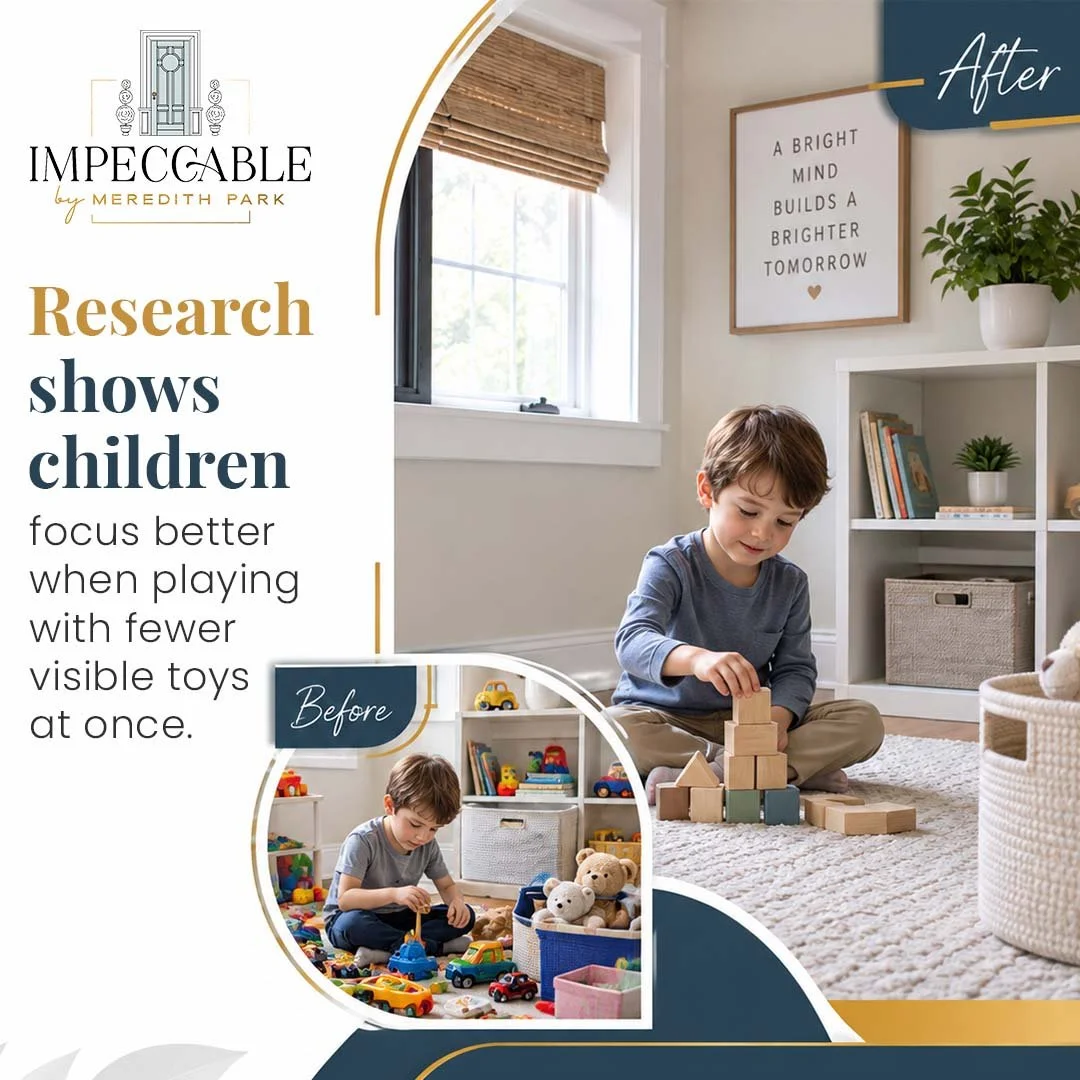
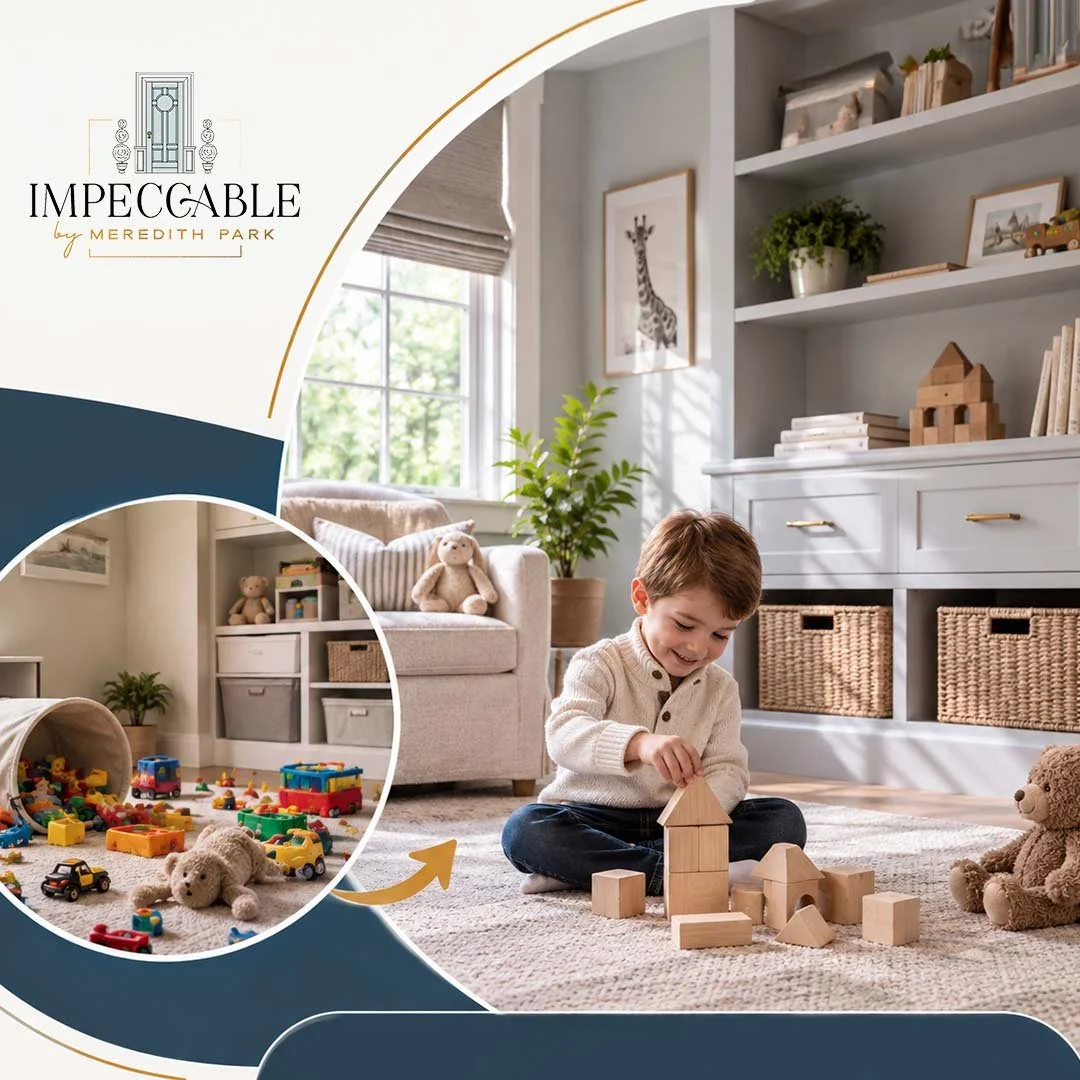
A kids' room stays organized when storage is built around rotation, not accumulation, so only a portion of toys and school items are visible at once while the rest stay contained out of sight. A room designed this way stays tidy well beyond the initial weeks of the school year. As residential interior designers, we build this kind of rotation system into every kid's room we design at Impeccable by Meredith Park.
Key Takeaways
Rotating storage keeps a room from feeling overwhelmed by every toy at once.
Closed cabinetry and bins hide clutter while keeping items easy to find.
Labeled zones teach children where things belong, which supports lasting organization.
A well-led storage plan is built into the room's design, not added as an afterthought.
Why Rotation Matters More Than More Storage
It is tempting to solve clutter with more shelves or bins, but research points to fewer items in view. A University of Toledo study published in Infant Behavior and Development found toddlers played much longer with individual toys when given four toys instead of sixteen, a principle that also applies to how a room stays organized.
For families across Glenview, Chicago, and the surrounding suburbs, this often means designing storage that hides most items while keeping a smaller, rotating selection accessible.
| Storage Type | Best For | Design Note |
|---|---|---|
| Closed cabinetry | Toys and games not in current rotation | Keeps volume out of sight |
| Labeled bins | Small items like art supplies or blocks | Teaches sorting by category |
| Window seat storage | Seasonal items or off-rotation toys | Doubles as seating |
| Closet systems | Clothing and shoes | Adjustable shelves grow with the child |
What Makes a Storage Plan Last All Year
A storage plan holds up when it is built into the room during design, not added with organizers later. As part of our residential interior design services, we plan closets, built-ins, and bins around how a child uses a room, then leave room for the system to adapt as interests change.
We also look for pieces with character, such as a vintage trunk repurposed as toy storage, so a functional solution still feels part of a considered home rather than a generic bin.
Frequently Asked Questions
How many toys should be visible at once?
Keeping a smaller, rotating selection visible, with the rest stored out of sight, tends to support better play and easier cleanup.
Do built-ins work better than freestanding storage?
Built-ins make efficient use of a room's exact dimensions, though well-chosen freestanding pieces can work well in smaller budgets or rented homes.
Can storage solutions grow with a child?
Yes. Adjustable shelving and modular bins can be reconfigured as a child moves from toys to school supplies and hobbies.
Should storage match the rest of the bedroom?
Storage works best when its finish and style match the room, so it reads as part of the design rather than an add-on.
Working With Residential Interior Designers on a Storage Plan
We are Impeccable by Meredith Park, one of the residential interior design firms serving Glenview and the greater Chicago area, and we approach every project with one accountable designer leading it from concept through installation. As residential interior designers, we build storage into a room's plan from the start, so it stays organized well past the initial weeks of school.
If clutter keeps returning to your child's room no matter how often you tidy, reach out, and we will help you design a system built to last. Call us at (773) 551-5944 or email impeccableoffice@gmail.com.
